Intro
No one would blame you if you did not know where Sauk County Wisconsin was on a map, nor would you be wrong if upon doing some google research you felt that Sauk County’s claim to fame was centered around America’s largest waterpark, or that it is the home to some of the largest indoor waterparks in the United States. However, for a small period in the late 19th century, Sauk County was the center of a farming boom which was as rich as it was short, the Wisconsin Hop Boom.
Background of Hops and Brewing
I am sure there are some if not many of you watching who are not necessarily with the finer points of brewing beer and as a result are not entirely sure what hops are. Most simply hops are the female flower of a vine plant known by its scientific name of humulus lupulus. These flowers have been since the 1516 Reinheitsgebot, or German Purity Law, one of the 4 main components of beer, along with grain, yeast, and water. The hops are dried out and used both to add flavor and bitterness to the beer as well as aiding in the preservation of beer and lengthening the shelf life.
History of Hop Cultivation in the US
In North America the areas shown on screen are the most well suited to commercial hop growing, being north of the Ohio Valley, south of the Canadian Shield and having between 35 and 55 inches of annual precipitation. Hops do grow naturally in North America however it would be in 1629 that the Massachusetts Bay Company would bring the first commercial hop plants to the colonies. From there hop cultivation spread throughout the eastern seaboard.
For most of the 19th century, New York state was the center of hops cultivation. By 1860 the state of New York was producing 9.6 million pounds of hops across the state, centered mainly in Otsego county, where more than a third of New York’s crop was harvested. In that same year in Wisconsin a mere 130 thousand pounds were harvested, centered around Jefferson county near Milwaukee, the brewing hub of Wisconsin.
Immigration to Wisconsin
Wisconsin was changing in the 1850’s, a new wave of immigrants was arriving in Wisconsin with a thirst for beer, and the expertise to make it. The second half of the 1800s is known for one of the first great rushes of European immigration. In 1850 there were a mere 34,519 German immigrants, by 1860 that number had grown to 123,879. Nearly 10% of the entire German population in the United States was living in Wisconsin. Men such as Frederick Miller and Frederick Pabst had set up breweries in the growing city of Milwaukee Wisconsin to feed the growing demand for German style beer in the young state, and one ingredient they needed was hops.
Hop Louse and Rise of Sauk County
Wisconsin’s near non-existent hop farming industry gained its chance to shine in the 1860s when the hop louse, attacked crops in New York State coupled with late frosts, led to a drastic rise in demand and prices of hops. When hop farmers in Wisconsin began to reap harvests that were equal to or greater than an entire year’s wages others took notice and by 1866 the boom was on. In 1861 prices on the New York Market were 25 cents per pound, however by 1867 the price had nearly tripled to 70 cents per pound. Farmers in Wisconsin began planning en-masse using credit lines to put forward the costly infrastructure and labor costs required to bring a crop of hops to market.
Factors which fed the Boom
The mix of German immigration along with the sudden drop in production in New York primed Wisconsin to be the next hop major hop growing area of the United States. Wisconsin also had an abundance of land in the 1860s as much of the state was still sparsely populated only 20 years after it had attained statehood. Furthermore the abundant forests and availability of sawmills made it easy for farmers to access the large amount of equipment needed to grow the labor intensive crop.
Affluence as a result of Hop Boom
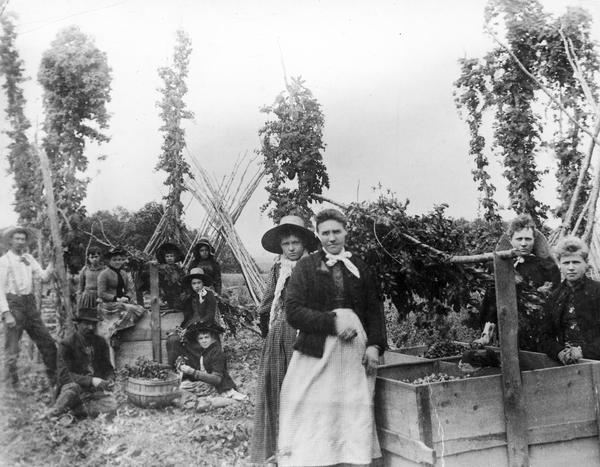
The sudden emergence of a cash crop such as hops had a profound effect on the economy of Sauk county. Farmers were suddenly able to raise up to $1600 per acre for their hops, the equivalent to nearly $50,000 in 2020 equivalent dollars. By 1867 2,548 acres of land were dedicated to hop farming in Sauk County, and the haul was nearly 4,000,000 pounds of hops, accounting for some $2,000,000 of revenue with a scant population of only 23,808 citizens. One account stated that the residents of Sauk county found themselves “driving around in fancy phaetons (a type of carriage)” and that homes were “bursting with pianos and other new furnishings”. Stores exist of farmers receiving nearly unlimited credit lines simply by promising to pay at the end of the hop harvest, and that often after covering all expenses farmers would have more than a year’s wages left over. Some of the iconic homes and buildings of Reedsburg and Sauk county were also built by farmers, or merchants flush with cash during the heights of the hop boom such as the Hackett Home at 612 Main St in Reedsburg, the Harris House at 226 N Pine Street, or the Reedsburg Brewing Company building (now a national historic landmark). Entire towns even came into being such as Hillpoint, centered around a mill which was setup to produce hop slats along Narrows creek in rural sauk county.
The fall of Hops in Wisconsin/Return of NY
Alas the unlimited credit and years of plenty in Sauk county and Wisconsin could not last. By 1869 the farmers on the east coast had figured out how to control the hop louse and returned to their normal production. What ensued was a flood of hops onto the open market and the once sky high hop prices of 1867/1868 fell to an all time low. Farmers who were over extended to take advantage of what seemed like a nearly unlimited flow of cash resulting from the hop boom found themselves bankrupt. Meanwhile local religious groups such as the Presbyterians and Baptists had come out with statements against alcohol and all activities related to it.
By 1890 a scant nine hop farms were left in Sauk county and production across the state had fallen to 1.9 million pounds across the entire state, of which Sauk accounted for only 235,000 pounds. By 1910 hop farming had all but disappeared from what would become “The Dairy State” ending one of the great agricultural gold rushes of the 19th century and closing a little known chapter in Wisconsin’s history.
Sources:
 Faas Historical Research